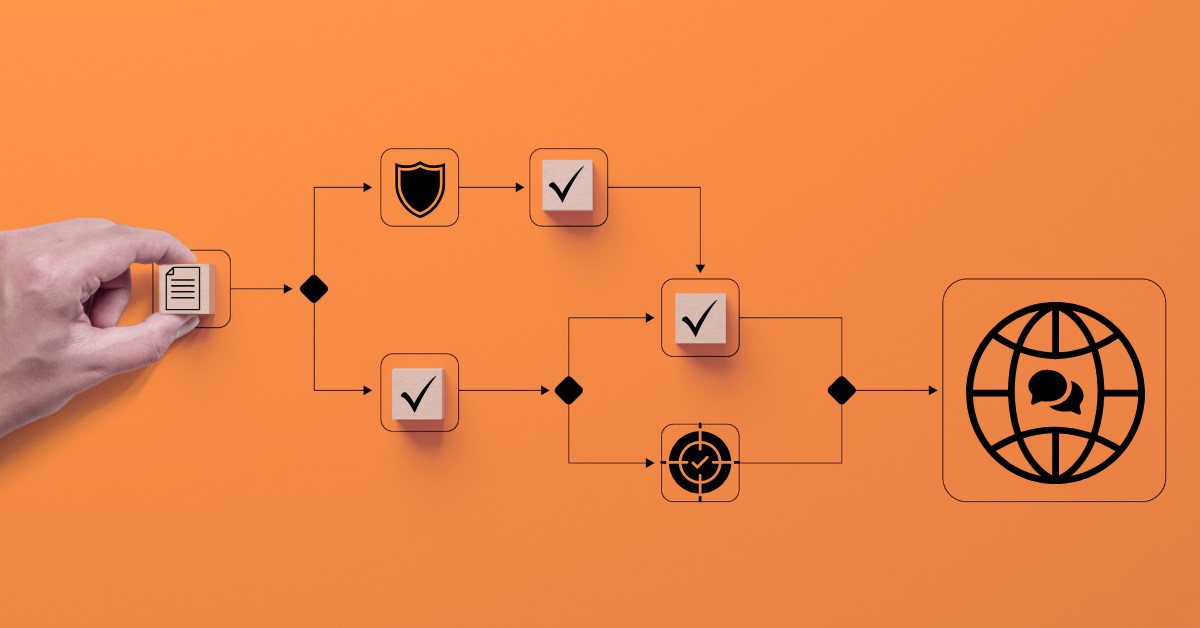
At TLC, we are developing the Multilingual Integrity Standard™ — a governance framework for accountable, defensible multilingual communication in regulated and high-stakes environments. To assess where your organization stands today, download our Translation Defensibility Checklist.

Accuracy gets you to the finish line. Defensibility keeps you there.
Imagine a translation that passes every quality check. The terminology is correct. The grammar is sound. A senior reviewer signed off. By every traditional measure, it is good work.
Then an audit happens. A regulator asks to see the process behind the document. Questions arrive in writing: Who produced this translation? What source version was used? Was AI involved? Who validated the output? What controls were in place?
The organization searches for answers. Some are partial. Some are missing. The documentation was never built to answer these questions, because no one thought it would be asked.
This is the defensibility gap. And it is one of the most consequential risks in regulated multilingual communication today.
What Accuracy Was Built to Answer
For most of the history of professional translation, accuracy was the right standard. It asked the right question for its time: does this translation faithfully reflect the source text?
 That question still matters. It will always matter. A translation that distorts meaning, omits critical information, or introduces ambiguity is a failure regardless of what governance documentation accompanies it. Accuracy is the floor.
But accuracy was designed for a world where translation was a contained, human-led task. Volumes were manageable. Review cycles were forgiving. The consequences of a linguistic error, while sometimes serious, were often isolated and correctable.
That world no longer describes the environment in which most regulated organizations operate in.
What Changed — and Why the Old Standard No Longer Covers the Risk
Three forces have converged to make accuracy, on its own, an insufficient safeguard.
First, AI has fundamentally changed the risk profile of multilingual workflows. AI-driven translation enhances speed and reduces costs. That efficiency is real and valuable. But AI failures are different from human failures. Human errors tend to be localized and visible. AI errors scale quietly. They replicate patterns. They introduce consistency in places where judgment is required. And they often sound plausible enough to pass a casual review without triggering any alarm.
 In regulated environments, plausibility is not a sufficient safeguard. Quality can no longer be assessed only at the sentence level. It must be evaluated at the system level.
Second, multilingual content in regulated industries is no longer just communication. It is part of the compliance record. Translated clinical documentation, informed consent materials, safety instructions, public notices, and employee policies are not simply informational. They carry legal weight, regulatory obligations, and in some cases, direct consequences for the people who rely on them. When those documents exist within a regulated framework, the standards applied to them must match.
Third, accountability for language decisions has fragmented. Modern multilingual workflows involve many hands. Content is drafted by subject matter experts, adapted by marketing, reviewed by legal, translated by AI or human linguists, post-edited by contractors, and sometimes revised further by in-country teams. At each step, responsibility narrows. Clear ownership rarely materializes. When something goes wrong, tracing the decision that caused it can be nearly impossible without intentional documentation.
AI does not create governance problems. It amplifies the ones that already exist.
What Regulators and Auditors Actually Ask
The shift from accuracy to defensibility becomes concrete when you understand what regulators and auditors are actually looking for.
 They are not primarily asking whether the translation sounds correct. They are asking whether the organization can demonstrate that the right process was followed, the right controls were in place, and the right people were accountable.
The questions they ask look like this:
- Who owned this multilingual content and who was accountable for its accuracy?
- What source version was used, and how was it controlled?
- Was AI or machine translation involved, and how was that use governed and documented?
- Who reviewed and validated the output, and on what basis?
- What happened when errors or ambiguities were identified?
- Can the organization reconstruct the decisions behind this document if challenged?
These questions are not theoretical. They surface in FDA inspections, EEOC complaints, educational equity reviews, insurance coverage disputes, and employment litigation. They arise whenever a translated document is central to a contested outcome, and someone needs to understand how it was produced.
An organization with strong linguistic output but no documented process cannot answer them. An organization with a governed, traceable process can, even if the specific translation was imperfect, because it can demonstrate that the right controls existed and that any failure was caught and addressed.
This is the difference between accuracy and defensibility. Accuracy asks whether the translation is good. Defensibility asks whether the process can withstand scrutiny.
Defensibility Is Built Before the Translation Is Delivered
This is where many organizations make a critical error. They treat defensibility as a retroactive problem. Something goes wrong, and they try to reconstruct the process after the fact. That rarely works, because defensibility is not a review. It is a design choice.
W. Edwards Deming put it plainly: quality cannot be inspected into a product. It must be designed into the system that produces it.
 The same is true for defensibility. A review that happens at the end of a translation workflow cannot retroactively create audit trails, version control, role documentation, or AI governance records that were never built.
Defensibility lives upstream. It lives in how the workflow is structured before work begins. In how roles and accountability are defined. In how AI use is documented and governed. In how terminology decisions are made and recorded. In how review criteria are established and applied consistently. In how change control is maintained when source content is updated.
A linguistically perfect translation produced by an undocumented process cannot be defended. A well-governed process produces defensible output even when imperfections exist.
This is not an abstract standard. It is a practical discipline. Organizations that build defensibility into their workflows are not doing more work. They are doing different work, at the right stage, in a way that protects them when it matters.
What This Looks Like Across Regulated Sectors
The defensibility gap shows up differently depending on the sector, but the underlying pattern is consistent: a translation that is linguistically adequate fails when the process behind it cannot be demonstrated.
The Shift Organizations Need to Make
The organizations best positioned for what is coming are already beginning to ask a different question. Not just: is this translation accurate? But, is this multilingual communication governed?
That shift requires treating multilingual workflows as controlled business processes, not downstream linguistic tasks. It requires assigning clear ownership of language decisions, defining how and when AI may be used, establishing review criteria that are consistent rather than ad hoc, maintaining documentation that captures not only what was done but why, and building systems that make the process visible and auditable.
None of this is incompatible with efficiency. In fact, organizations that govern their multilingual workflows well often discover that the clarity those structures create reduces rework, shortens review cycles, and makes scaling into new languages and markets more manageable.
Defensibility is not the enemy of speed. It is what makes speed sustainable in environments where the stakes are high.
A Closing Thought
Regulated organizations are already being held to the defensibility standard. Whether they know it yet often depends on whether something has gone wrong.
The question is not whether defensibility will eventually be required. It is whether the system was built to provide it before it is needed.
Accuracy remains essential. But in regulated environments, it is the starting point, not the finish line. The organizations that recognize this early will be better positioned to protect their people, their operations, and their credibility when it matters most.